top of page

Late 19th-/Early 20th-Century collecting of human remains in colonial contexts: a transimperial perspective
WEBINAR
30 June 2023 (Friday)
Daniel Foliard (Professor, Université Paris Cité)
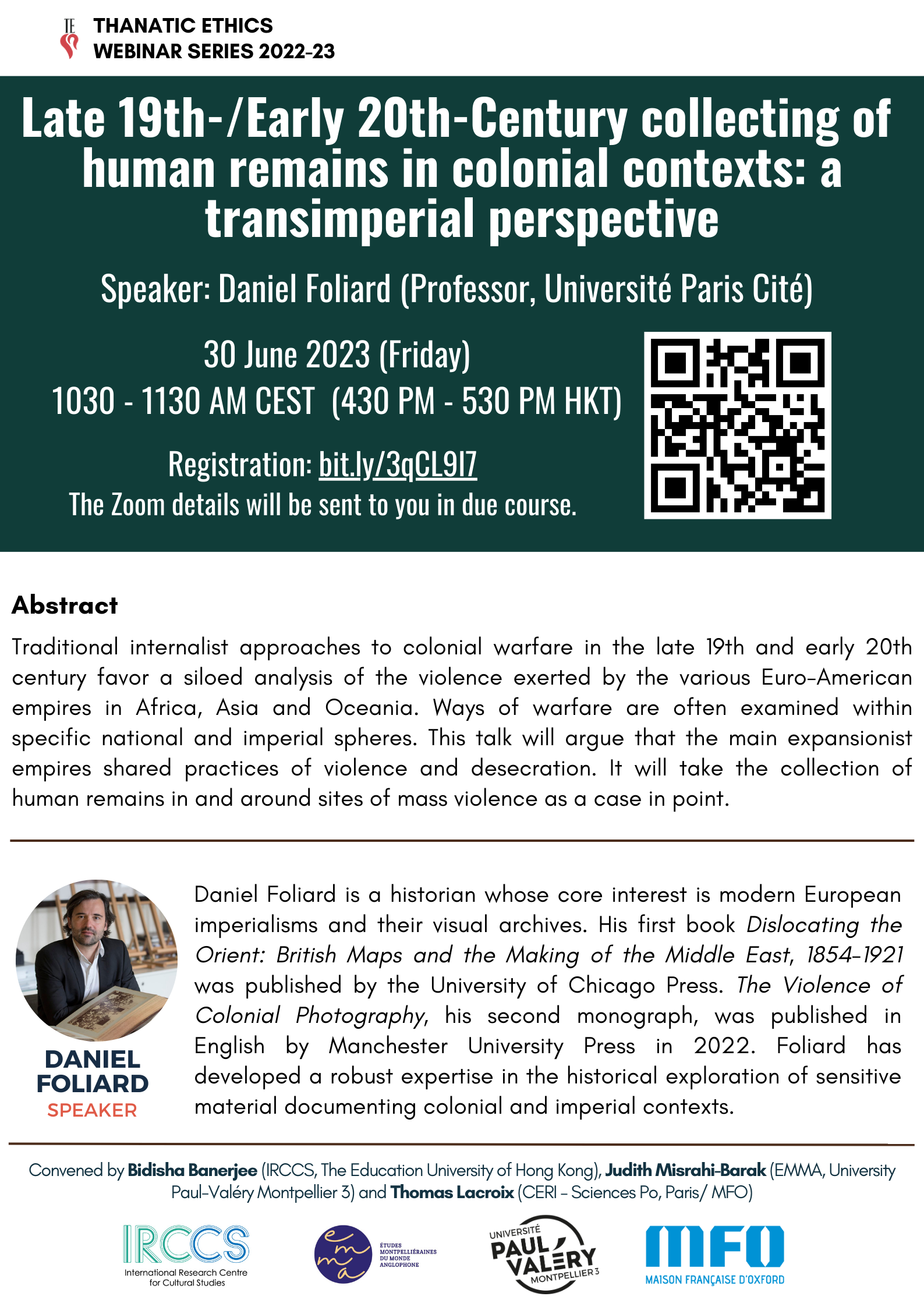
About this event
Traditional internalist approaches to colonial warfare in the late 19th and early 20th century favor a siloed analysis of the violence exerted by the various Euro-American empires in Africa, Asia and Oceania. Ways of warfare are often examined within…
RESOURCES
Winter Webinar Series:
Late 19th-/Early 20th-Century collecting of human remains in colonial contexts: a transimperial perspective
Date: 30 June 2023 (Friday)
Time: 1030 - 1130 AM CEST (430 PM - 530 PM HKT)
Title: Late 19th-/Early 20th-Century collecting of human remains in colonial contexts: a transimperial perspective
Speaker: Daniel Foliard (Professor, Université Paris Cité)
Abstract:
Traditional internalist approaches to colonial warfare in the late 19th and early 20th century favor a siloed analysis of the violence exerted by the various Euro-American empires in Africa, Asia and Oceania. Ways of warfare are often examined within specific national and imperial spheres. This talk will argue that the main expansionist empires shared practices of violence and desecration. It will take the collection of human remains in and around sites of mass violence as a case in point.
About the speaker:
Daniel Foliard is a historian whose core interest is modern European imperialisms and their visual archives. His first book Dislocating the Orient: British Maps and the Making of the Middle East, 1854-1921 was published by the University of Chicago Press. The Violence of Colonial Photography, his second monograph, was published in English by Manchester University Press in 2022. Foliard has developed a robust expertise in the historical exploration of sensitive material documenting colonial and imperial contexts.
bottom of page